Saturday, August 17, 2013

The services that never stop

Tuesday 7/16 Part 1: Central Library of Edinburgh

What a library!  Not only is this library huge, it also offers an amazing array of services for its patrons and the community across all of its branches.  And the accolades reflect this... they have won, or been a finalist, for the "Best Library Service in the UK" award, and they have a 97% customer satisfaction rate.

The library's focus centers on 3 aspects: social, digital, and physical, and using this, they have branded themselves in a way that attracts users of all ages through special programs.  Reading groups, special events, and age-specific publications/newsletters are just a few examples of the social gatherings the library offers to bring together it patrons with common interests.  Their digital initiates include increasing electronic resources and access, and they are heavily invested in social media.  The suite of online services is staggering, and includes the website, eventbrite for social events, the "Your Edinburgh" site which uses crowdsourcing to gather its info, and Special Collections online exhibits, to name a few.  One could spend hours exploring all the cool things they have on their website.

Two of their largest programs are the partnership with Dyslexia Scotland, and the Reading Champion Project.  Both utilize special programs to encourage library use and reading, as well as awareness and support for issues of literacy.  They are both great programs which do a lot of good for the local community.

My favorite part of this visit was when our tour took us into the Reference Library.  This part was built in 1890, and has not changed much since its founding.  The original space consisted of two parts, one for men and one for women.  It is a beautiful room, but unfortunately the collection has outgrown the space and the library is struggling to find adequate room for its physical collection... as is the case with most libraries today.




What's in a name?

Monday 7/15 Part 2: National Records of Scotland

Ahh, archives... my favorite

The National Records of Scotland, as it is now, is a result of a recent merger between the National Archives of Scotland and the General Register Office for Scotland.  This huge institution serves as both the records management functions, for things like the census, and the archival functions which maintain the heritage collections.  It is such a large, well-oiled machine, and it represents everything that a national archival organization should be.

One of the biggest tasks that this organization handles is the multiple websites for all of the different collections.  For example, the ScotlandsPeople website is the access point for one of the largest genealogical resources in the world, and the Scottish Register of Tartans allows users to search the tartan database, compare different tartans, or even register a new one.  Some sites are now only partial, but it is a major priority of the NRS to get these sites up and fully functional to provide as much access as possible to their holdings.

We went on a brief tour of the main building - there are 3 buildings in total - and it was really interesting to see all of the different departments of a large, working, archival environment.  The building itself was purposefully built to hold an archive, with multiple storage rooms all labeled by what they hold.  And the entire place is built from stone to minimize the fire risk to such valuable collections.  Their reading room is outfitted with multiple computers, which provide access to the digital catalogs, and large tables, where patrons may view the materials they have requested.  Though they have digitized a large portion of their collection, like most archives they still have quite a large amount of paper records, and the digitization efforts have slowed due to funding cuts.

The last part of our visit gave us an opportunity to look at some examples of items that the archives has.  Margaret, our visit guide, pulled items that related to our home states, which was a really fascinating thing to see since we were in Scotland.  But yes, there were items related to New York, Pennsylvania, Mississippi, and even Colorado.  It was a nice, personal way to end what was another amazing visit to a great institution.


Thursday, July 25, 2013

to Edinburgh we go

Sunday 7/14-Monday 7/15: Arriving/A quick visit to the National Library, Edinburgh

We made the long, long, LONG, bus ride to Edinburgh on Sunday, ending up at one of the most beautiful estates I have ever seen: Dalkeith Palace.  Sprawled over 800 acres, the estate is the home of a University of Wisconsin study abroad program, and we were lucky enough to stay there for our journey to the libraries of Edinburgh.  Built in the early 18th century, it still has some of the original wood paneling and marble decoration, and we were encouraged to open the many numerous doors to explore where they lead.  Now, it was a little different than what I'm used to as far as living conditions - I had to sleep in a 7-person room, and there are only 2 bathrooms between the 50 or so people that were there - but it really was a lovely estate... and it was quiet!  It really was so nice to get out of the city for a few days, and breathe the clean, (much) cooler air.

Our first visit for our trip was a quick stop at the National Library of Scotland.  Though not a scheduled tour visit, our professor did want us to stop by and explore a little.  This visit was especially exciting for me, as the Library has just recently put a Jane Austen display together, featuring a rare first edition of Pride & Prejudice.  Furthermore, the exhibit focused on the novel's influence over the last 200 years, and it's adoption, and evolution, in popular culture.  Though a very small display (only one case), it has a profound message; Jane Austen is now more popular than ever, and her works and themes are still relevant today.  It was a nicely done mini-exhibit, and I am so, so lucky to have been able to see such a rare treasure as that first edition.

I couldn't take pictures at the Library, but here are some photos of Dalkeith.  Oh, and I forgot to mention the hairy coo.  What's a hairy coo, you ask?  It's a hairy cow, also known as a Highland Cow.  Really, it should be the co-mascot of Scotland; partners with the sheep.  They are so cute, and they have one at Dalkeith (though I don't have a picture of it).


A hairy coo: photo from wikimedia.org


Tuesday, July 23, 2013

Down into the basement we go

Friday 7/12: The British Museum Archives

The British Museum is a glorious, expansive, overwhelming place full of artifacts from around the world (let's not dwell on how the collection was created), and underneath it all is a little-known basement room full of treasures that few get the privilege of exploring: the museum archives.

Stephanie, the archivist, is what we call a "lone arranger," meaning she works alone.  Though she is part of the legal department, her responsibility is handling the museum archives, which consist of the business records of the museum; the 8 collecting departments are responsible for their own records.  Now, that may sound a little boring, but that is not the case at all.  Looking through some of the items that are in the collection reveals an almost humorous sentiment regarding the people, places, and things surrounding the museum in past years; the word 'sober' tends to appear frequently - which is not what one would expect to find.  The records start in 1753, and the current records are still added.  The only exception is the staff/personnel records, which are handled and maintained by the National Archives.

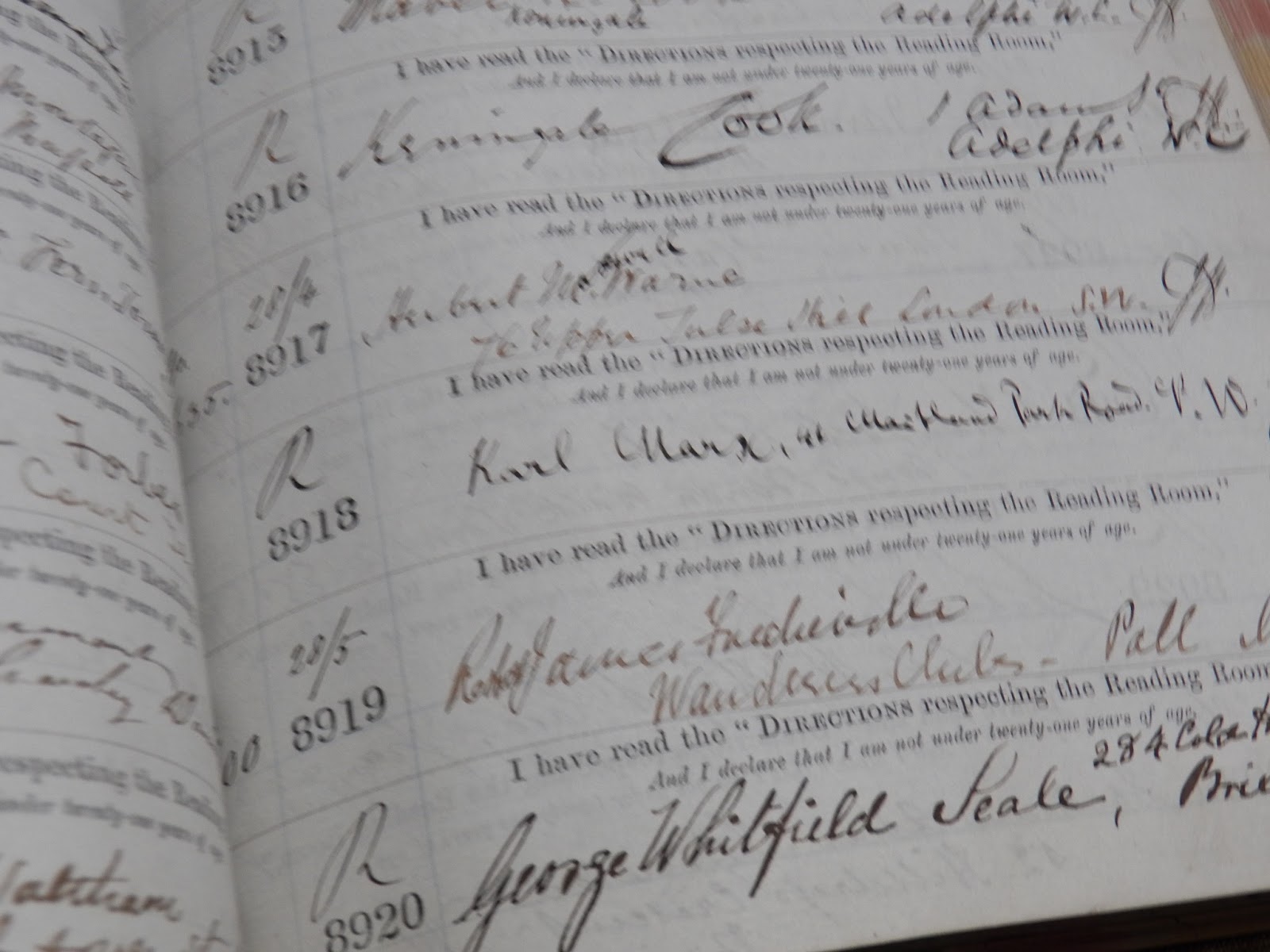
There is a reading room in the center of the museum, which is now closed off and used as temporary exhibition space, but as new space is being built, the reading room will once again be open.  The reading room records are held in the archives that we were shown, and they contain some interesting things as well.  Back in the day, a user would have to write a letter to the museum requesting access to the reading room, fill out the application, and then mail it back to the museum to have their request reviewed.  Stephanie showed us the applications from Bram Stoker, Beatrix Potter, and T.S. Elliot, to name just a few.  If a person came into the reading room, they were required to sign in, and Stephanie showed us some famous signatures in the registers that are held in the archive including Beatrix Potter and Karl Marx.  There are also some fascinating artifacts contained within this collection, including the shell from the bomb that hit the Coins & Metals room during the Blitz.


Both before, and after visiting the archives, I walked around the museum a bit to find the things I absolutely had to see.  It gets pretty busy in there rather quickly, so I had must must-see list ready.  The Rosetta Stone was first, of course, the mummies, and the Vindolanda Tablets (which I'm sure you've never heard of).  There was also an exhibit, "Life and Death in Pompeii and Herculaneum," that I visited, and it was spectacular (I couldn't take pictures though, so you'll just have to trust me).


"Dr. Livingstone, I presume"

Thursday 7/11: The Royal Geographical Society

Founded in 1830 as the Geographical Society of London, the Royal Geographical Society (or, RGS as I will call it throughout this post) aims to promote the science of geography through exploration, teaching, and academic study; the latter now being the primary focus.  We visited the reading room, which opened in 2004, with the principal librarian, Eugene, as our guide.

The RGS has over 2 million items in its collections, and half of that is just maps.  They have about 2,000 atlases with the oldest dating to 1490.  A large quantity of images is also held in the collections, mainly photos that document the history of British exploration.  About 15,000 images have been digitized, both for the sake of user access, but also to protect some of the most fragile items.  Books only make up a relatively small part of the collection at approximately 250,000 volumes, 150,000 of which are books and the rest bound periodicals.  The remainder of the collection consists of archives, fellowship certificates (which help with genealogy), and museum objects, or artifacts.

Interestingly, RGS does not use any classification scheme, but rather a shelf marker system that labels each item with its location on a particular shelf.  They do, however, enter everything into their database which provides a central access point to the collections.  We've seen this a lot in the places we have visited so far, and I find it interesting that this is more the case than not, as opposed to the US where similar institutions will generally always have some sort of classification system in place.

Eugene had laid out the reading room table with oodles of goodies for us to look at, and as he went around the table explaining the objects, he also gave us a (much needed) lesson in British geographical history.  Below are some pictures of the objects he showed us, including the hats that Stanley and Livingstone were wearing when they met, Darwin's pocket sextant from his voyage on the Beagle, a petrified biscuit and piece of chocolate, Shackleton's balaclava, Mallory's boot, and some beautiful hand-sketched maps from some of these famous explorers.  These items have found a safe, and permanent, home at the RGS, where they will be well-preserved and taken care of by this team of professionals.


Monday, July 15, 2013

Yeah, you can touch that!

Wednesday 7/10: National Art Library at the V&A

We found ourselves at the Victoria & Albert (V&A) museum early Wednesday morning after a very late night (our bus didn't get back from Stratford until 2:30am!).  And though I am so not a morning person, this visit would prove to be worth the severe sleep deficiency I was experiencing.

Our lovely guide, Sally, took us through the National Art Library on a behind-the-scenes tour that very few get to see.  Opened to the public in 1858, his library at the V&A is one of the top 3 art libraries in the world, and its strength lies in its holdings which number over 1 million items.  The collections cover many countries and many time periods, and all topics in the arts.  The library is a closed-access facility, meaning that items are not loaned out, and all requests for materials are made through the online system.  Items are issued through a counter, but in order to provide better service to their users, they are working to implement a self-service counter that will streamline retrieval.

Interestingly, the books have no classification system that we would be used to in the U.S.  Instead, books are shelved by size, and an in-house numbering and shelving system is implemented.  Organizing the books in this way allows for maximization of space, an important commodity when storage is limited; there are still many books in the intake area which are still waiting for homes.

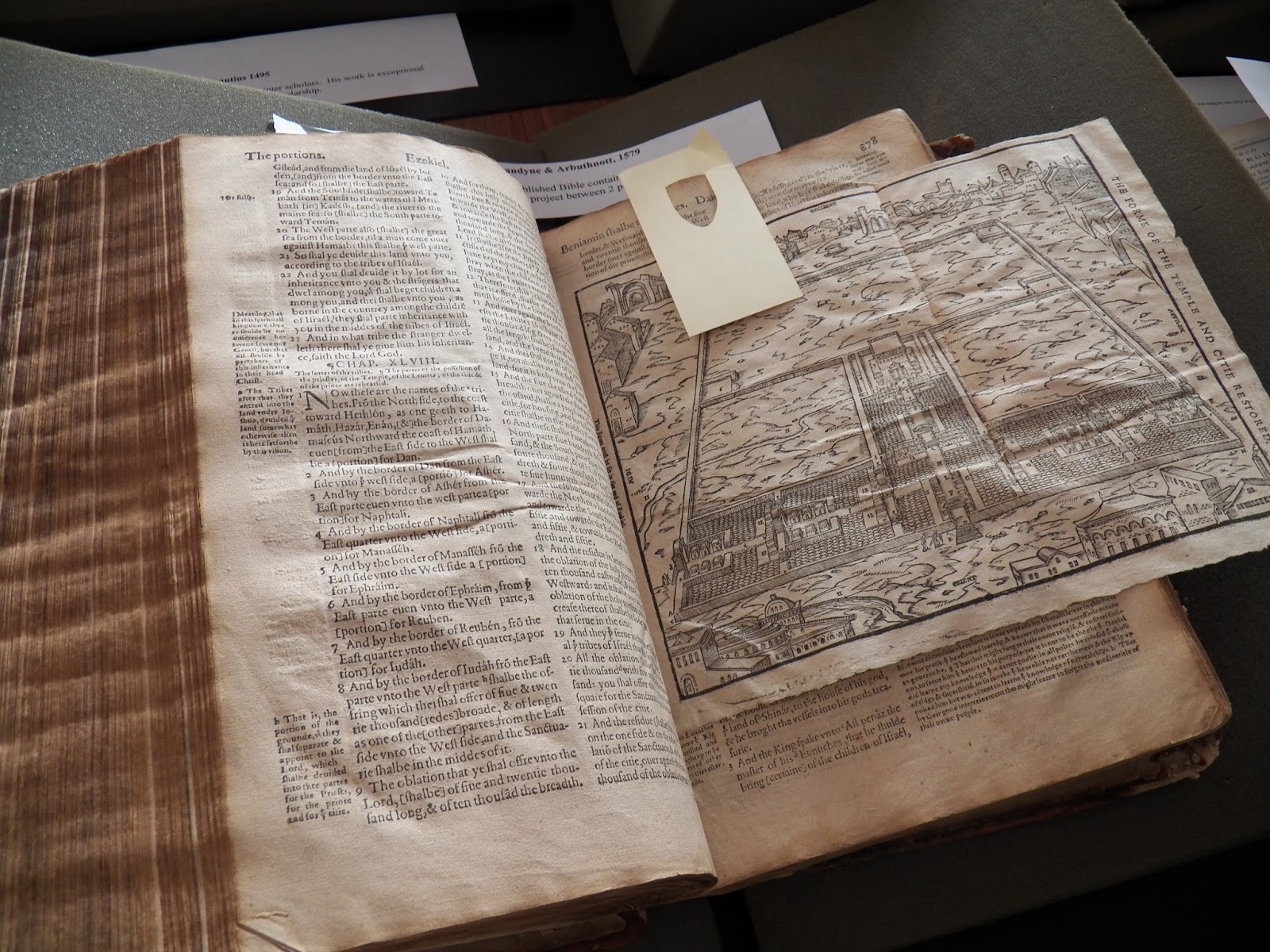
The last part of our visit was a very special treat.  Sally brought us to a room with a table that was covered in beautiful books.  She explained each one in order of its date, beginning with an exquisite illuminated manuscript, a Book of Hours, from the early 15th century.  Next was an exact reproduction of one of Leonardo da Vinci's notebooks, worth huge sums even as a copy.  Other items included a book of prints from Edward Leer, the manuscript from David Copperfield (in Dickens' own hand), and a drawing from Picasso.  Not only did we get to see, and touch, these amazing works, we also were shown some examples of books as works of art including a book sculpture by Genevieve Sielle, and a binding and housing for one of Dickens' Edwin Drood.

What a(nother) fantastic day!

Friday, July 12, 2013

All the world's a stage...

Tuesday 7/9: Stratford-upon-Avon

My class took a day trip to Stratford-upon-Avon, the birthplace of Shakespeare, on Tuesday.  We didn't have any appointments to visit institutions, so we were pretty much free to do whatever.  I'm not really a fan of Shakespeare (gasp!), so I just wandered around the town exploring for most of the day, and spent the later part of the afternoon in a coffeeshop working on the blog and other internet-related work.

The treat of the day was later that night, as we had tickets to see As You Like It performed at the Royal Shakespeare Company.  I have read that play back in school (a long, long time ago) but had not yet seen it performed.  This was a modernized interpretation, and it was excellent.  I really liked everything about it... well, except for the weird dancing at the beginning - I really don't know how to explain it, it was just strange. But overall, it was really good, and again I am just awestruck at all of the awesome things I get to do on this trip.


Shakespeare's Birthplace

Photos from C.Boddie