Thursday, July 11, 2013

sidebar: Hampton Court Palace

After our class trip to the British Library, a friend and I traveled out to Hampton Court Palace for the afternoon.  It's about a half-hour train ride out of central London, and what a change from the city in such a short distance.  Built on the Thames riverbank, it was one of Henry VIII's favorite places.  Over time, the palace was expanded and rebuilt, until work stopped in 1694, leaving an unfinished structure of two distinct styles.  And oh, the chimneys.  There are so many of them, and each one has a different design.  Hampton Court also has a maze, which I'm happy to say we successfully navigated (see, I do have a good sense of direction!), tennis courts, and beautiful, expansive gardens.  I think my favorite part was the chapel.  It was so spectacular, and breathtaking.  We could only go in at the balcony, as the organ was being cleaned and tuned, but that was all that was needed.  What a truly amazing place, and as I walked through the rooms I imagined Henry VIII and his court spending their time in these walls, going about their business - and I felt very lucky to have been able to come here.


Tuesday, July 9, 2013

Bring on the book: A day at the British Library

Thursday, July 4:  While all of you across the pond were celebrating Independence Day, our class visited one of the most British institutions possible: The British Library.  Formed about 40 years ago as part of the British Museum, the collections were spread across several locations throughout London.  Today, the Library is only made up of two buildings; the storage facility at Boston Spa, and the new main building at St. Pancras, which opened in 1997.

The building itself is an interesting topic of discussion.  Many think it an ugly eyesore, including Prince Charles; but aside from its controversial appearance, it is an excellent facility.  There are 11 reading rooms with over 1,200 seats available.  A researcher requests the items they wish to view, and the books are pulled from the stacks (some of which are in the basement, some of which are at the Boston Spa facility), and delivered via an intricate rolling delivery system that snakes its way throughout the building.  It's quite a remarkable system, which uses only barcodes to track items throughout the delivery process; there are no plans for RFID tracking at this time.  Any one can request any item through the online catalog, even those from King George's Library (which I'll talk about later), however in many cases a facsimile copy is provided rather than a rare, delicate item.  And this is not a lending library, meaning items are not taken out of the building.

Considered the National Library of England, the British Library contains nearly 200 million items in all subject, and in all languages; and they add approximately 1 km of shelving each month... that's a lot of books!  As they are a copyright library, they take 1 copy of every book published in the UK and Ireland, and are constantly adding many international titles as well.  If that weren't enough, they are now archiving every website in the UK as well.  The collection also includes artifacts, a large amount of maps, a philatelic collection, and copious amounts of sound recordings, such as music and dialogue.

There were two highlights for me during my visit; King George's Library, and the Sir John Ritblat Gallery.  Upon walking into the building, the first thing you see is a glass tower full of beautifully bound, old books.  It holds the 85,000 volume library amassed by King George II, and donated by King George III under 3 conditions; the books were on public display, they were kept separate from the general collection, and they could be used by anyone.  The British Library still follows these conditions, but requiring supervision when the books are taken out for viewing.  The Ritblat Gallery contains the Treasure Room... and it's full of exactly what you'd expect - treasures!  But these treasures are books, the best kind.  They have many titles you would have heard of - a Gutenberg Bible, some Shakespeare manuscripts, and the Magna Carta - and some you may not - early maps of London, Princess Elizabeth's (as in Elizabeth I) prayer book, an Anglo-Saxon Chronicle, and (what I most wanted to see) Jane Austen's writing desk.  Sadly, the Lindisfarne Gospel is out on loan to Durham so I did not get to see it.

I plan on going back sometime this week to get my reader's card which will allow me to use the library's resources while I'm here doing research.  To the library!

Sunday, July 7, 2013

My journey to librarian mecca... The Bodleian at the University of Oxford

Think of a place you've always wanted to go... a place that you've dreamed about, you've yearned to visit, and you knew you wouldn't be complete unless you made that journey - and then do it. Go there and relish in every second that you breathe the air of your desired destination.  What would it feel like?  Well, let me tell you.

The Bodlein is not just any library... it's THE library.  Started in 1428, it is one of the oldest libraries in Europe.  Constructed of beautifully carved, golden-colored sandstone, its presences is overwhelming from the narrow street below.  Walking through the gate brings you into a courtyard, called the Schools Quadrangle, with numerous doors leading to unknown places, except for the obviously much larger library door just begging for me to walk through it - though this, come to find out, was the door for people who want to take tours.


Our tour began in The Divinity School, a room on the ground floor that was primarily used for oral disputations where students would stand to complete their examinations; written exams were not implemented until the 19th century.  The high, vaulted ceiling is decorated with over 400 carvings of coats of arms, and other items and symbols, all representing religious ideals, benefactors, and other important people associated with the school.  The room has been much unchanged from its creation, except for the addition of a door in the 17th century by Christopher Wren.  The door leads to the Sheldonian Theatre, where graduates receive their degrees.  Oh, and just an FYI, it's the room that was used as the hospital in Harry Potter.


The next room on the ground floor is the Convocation House, a 17th century-style meeting room where university business was conducted.  A large, looming throne resides over the dark stained, oak room, which is the seat of power for the Vice Chancellor.  These days the business is carried out in administrative offices, but this room is still used for elections and other functions.


The last room on the ground floor is the Chancellor's Court, and looks exactly as you would expect - like a small courtroom.  Cases concerning the university and its students would be heard here, but the room is not used as such today.

So where's the library, you ask?  Well, it's upstairs.  In those days books were very rare, and considered precious by their owners.  As a result, libraries were often built on upper floors to lessen the probability for damage should there be a disaster, such as a flood.  But before I talk about going to the library, let me just say a few things about the library.  It's collections are vast, and include over 11 million printed items.  It They aim to have one copy, and just one copy, of a book.  Their collection contains many, many priceless treasures, including many famous authors' first editions, 67 of the 100 known Hebrew incunabula, children's books, and the list goes on and on.  They are currently building a new facility to house and display many of these items for the public to view and admire (which is great, but I feel a little like I missed out).  Originally a manuscript library, it was destroyed, and later restored in 1602 by Thomas Bodley.

Walking into Duke Humfrey's Library... my heart stopped and my breath hitched in the back of my throat.  The smell, the view, the atmosphere all attacked my senses and I even teared up a little.  I know, enough with the emotions, but you just don't understand unless you've been there.  There is so much history in this place that you can taste it, and it's so overwhelming.  The Arts End, as it is known for its contents is full of beautiful, old bindings that stare down from their homes, protected behind the rope from those who do not know how to handle such treasures.  Many people don't know that most libraries chained the books to the shelves to prevent people from taking them out of the building, and The Bodleian was no exception.  One book has been left chained to show visitors how the system worked.  As the chain was attached to the outer edge of the cover, the books had to be shelved spine in hiding the identity of an item.  As a result, a numerical system was created to label the books for easy location, with a master list posted at the end of each shelf; the beginning of cataloging.  The layout is such that the shelves create alcoves for readers to immerse themselves in quiet study, each with a window for light; electricity was not added until 1927 (we could not take pictures, but you can Google it to see what it looks like).  And another FYI, this was the library from Harry Potter.

Our tour took us next to the Radcliffe Camera, which is considered the more modern part of the library.  Just a quick, few steps away, this two-story building is a popular destination for students to do their research.  The user-friendly atmosphere is noticeable upon entering, and though it is not as grand as Duke Humfrey's Library, it is still a beautiful space.  It is through this library that we made our way down to the basement, into the stacks below ground.  The entire area has been converted, and modernized, to allow for not only more storage and holding space, but for student use as well.  The shelves are interesting, built on a sort-of grid system that has rolling wheels sitting on tracks at the top, making them easier to move and access items.  The basement is also where the tunnel system for transport between buildings takes place.  Should a student want one item that is held in another library building, they can request that the item be pulled and delivered to where they are needed.

The journey has been completed... now if I could only think of some reason to return where they would actually let me use this library.

I spent the rest of the day wandering around Oxford to do a little shopping, and see the town.  Our class took a special tour of Christ Church later in the afternoon.. and when I say special, I mean it.  Our spectacular tour guide James took us through the back way, and into the private gardens only accessible to students and staff.  We stopped to view the secret garden door, a tree planted in 1640, and the grave of the former dean whose daughter was the inspiration for Alice (of Wonderland fame).  As this was the college Lewis Carroll spent many days, there are plenty of Alice references to be found, including the characters strategically, and almost secretly placed in a stained glass window in the Great Hall - which, by the way, was the Great Hall in Harry Potter.


Could these days get any better?

Saturday, July 6, 2013

I would walk 500 miles... to see an amazing library

Tuesday (7/2): Barbican Library, St. Paul's Cathedral Library

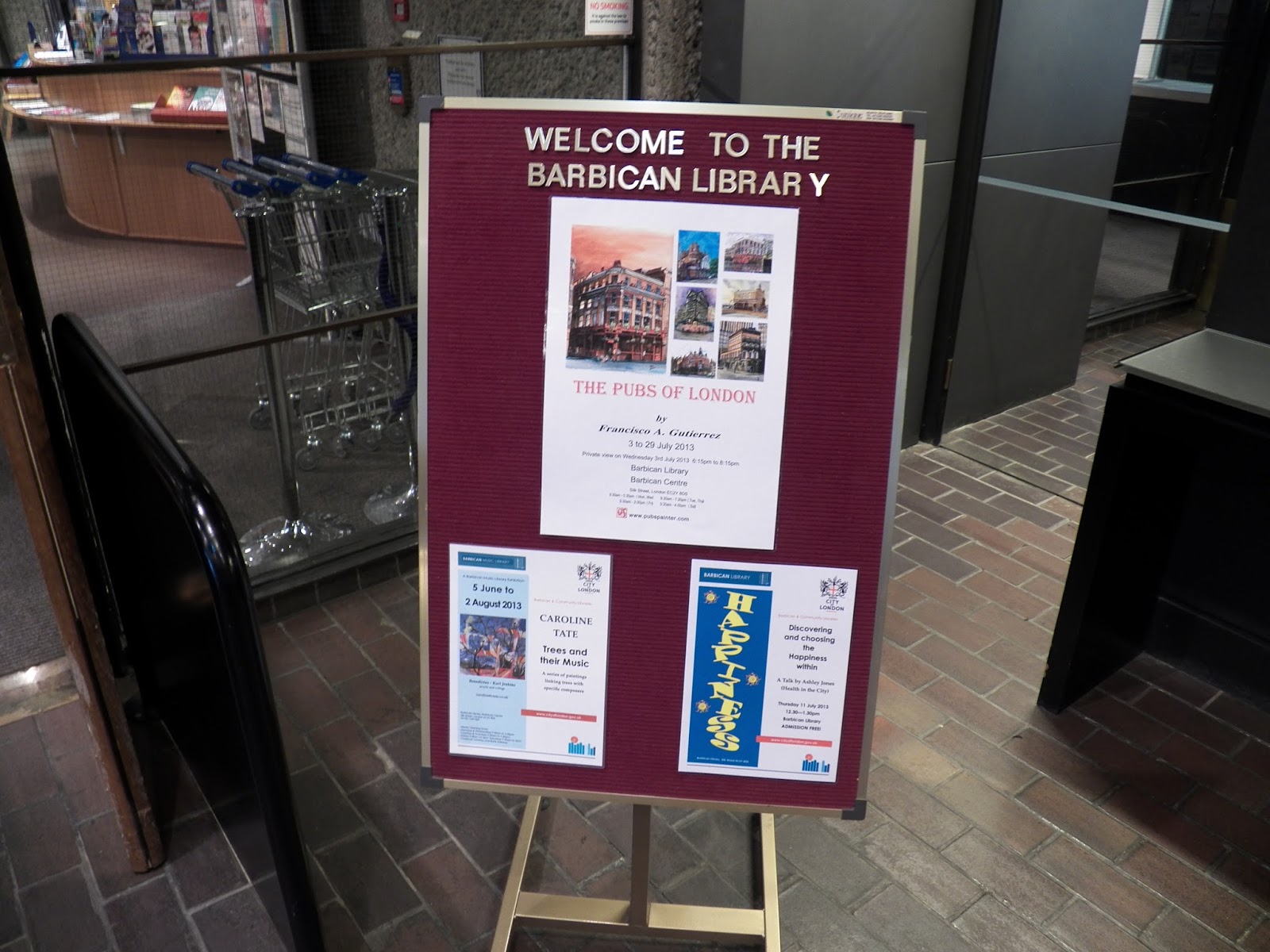
We visited one of the few public libraries in the city of London, the Barbican Library; it is actually only one of three.  Built on plague pits, the library is located in a massive arts and culture complex that consists of theatres, art galleries, and music venues.  It's mission is to facilitate learning and cultural growth through creative programming and educational offerings.  The Barbican is an amazing center, and truly one of a kind.

The library is located on the second level of the complex, and consists of three major departments; the main library, the children's library, and the music library.  Customers not only include the residents of the center, but the general public and local schools as well.  Interestingly, their demographic skews to the male half of the population, and age ranges from 25-45.  As a result, the collection skews more towards nonfiction, which generally differs from most other libraries.

The kinds of services offered are those one might find in a public library here in the states; computer and internet access, reference, featured items, and special interest offerings.  But there are quite a few differences worth mentioning.  First, and what I think is cool, is the home delivery service offered to home-bound patrons.  The customer selects which kinds of books they would like and a library staff member will deliver the books, free of charge, to their home.  After three weeks, a staff member will return to pick up the books for return, and drop off a new batch.  This really shows that they care about their patrons, and in a time when the entire library world is cutting left and right, these people still take the time to make sure that anyone who needs it, can still get access to library services.  Second, they offer a lot of life skills development assistance, ranging from basic reading to getting around town for newcomers.  Patrons are encouraged to use the library as a reference for not only reading, but their life as a whole.  Lastly, DVDs are lent by paying a fee.  For a small fee patrons can rent feature films for one week; in our libraries here, borrowing is free.  I think this is an excellent idea, as it generates extra revenue for library programming, and it cuts down on, what I like to call, DVD hoarding - if you've ever been in the DVD section of a public library, you know what I'm talking about.

The children's library offers an overwhelming amount of programming for its younger patrons, including reading groups, summer reading challenges, activities and events for National Book Week, and story times - just to name a few.  The staff is very active in the surrounding community, partnering with the schools in the area to coordinate programming and events for all ages.  Their collection has over 24,000 items, making it one of the largest children's libraries in London.

Located at the lower level of the library is the music library, one of the quietest areas of the entire space.  It is one of the two largest music libraries, the other being Westminster, and the two share resources in order to provide the best services for their users.  The music library has over 15,000 CDs, and numerous other resources including journals, theatre, reference, and sheet music - which is hard bound before it hits the shelves.  They even have two digital pianos for users to 'try before they borrow,' should they be unsure of their choice.  One of their most popular services is the subscription to streaming music, available to all patrons within the library.  Should you wish to hear any song, you can simply select and listen.

After our tour of the Barbican Library, we made our way to a corporate library, to meet one of our professor's former students.  Though I am not at liberty to discuss this visit, I can, and will say, that it was much like the corporate libraries that I had discussed during a special libraries class I had previously taken.  It was reassuring to see that there were many similarities between the corporate library world here, and that of our corporate libraries in the states.

Up nex was St. Paul's Cathedral, and its library.  Walking up to, and then into St. Paul's is breathtaking.  It's a beautiful structure, only made more so by the emotions it evokes when you walk through.  I knew this was going to be an experience I would never forget.  Our guide Joe was fantastic, and as he brought us up the 140 steps (to an area only accessed by staff), the anticipation was almost unbearable.  But we first made our way through what was intended to be a sort of museum gallery section which contained some very interesting artifacts; a Viking stone with rune markings, retired pulpits, and the original stone pieces of what was left after the fire.  Joe's message was simple, but clear; texts are not merely books, and books are not merely texts.  History, and its records, can be in almost any form if one is willing to open their eyes to search for the truth.  It was a powerful message, and one that I will keep with me as I journey onward through my career.

I can't even explain the moment when I walked into that library.  The pungent smell of decaying leather and aged paper and vellum was magical, and in the dim lights it was almost mysterious.  The shelves were absolutely beautiful, full of gorgeous, old bindings; the library of my dreams.  It would have been like walking back in time, except for the few modern touches that were just barley noticeable.  Many of the texts are from the late 16th century, as the library had to be rebuilt after the fire; their collection contains only 9 incunabula (pre-1501).  Only open to serious scholarly research, this library is an amazing treasure that I feel very lucky to have seen.  I do have a couple of pictures, but you will have to wait until I get home to see them!

It was an exhausting day, with a walk that seemed like it would never end.  But it's always worth it when a 12th century manuscript is at the end of the line.  Maybe that's just me :o)


Thursday, July 4, 2013

The first official day of class!

Monday (7/1) was our first official day of class.  We headed to Greenwich via a water taxi, one of the best ways to get up and down the Thames.  Getting off the ship, we were greeted by the Cutty Sark, the last surviving tea clipper, which is currently being restored.  The National Maritime Museum is made up of several parts; the Maritime Museum, the Royal Observatory, The Queen's House, and the Cutty Sark.  Our visit was to the museum, which contains the Caird Archive and Library.

The collection at this facility is the world's most extensive collection of maritime records.  Collections include topics such as the Royal Navy and the Merchant Navy, pirates, timekeeping, maps, exploration, and general maritime history.  Research guides for the collections are available on the library's website which provide information on the types of items available.  Researchers must then come to the library to access the items they wish to view.  Digitization of the collections has been minimal thus far - Master's Certificates, passenger lists, and ships plans - and there are no set plans as of yet to continue with digitization efforts.

The archive storage area arrangement was very interesting, as the stacks are arranged by a section topic; admiralty, dock yards, personal papers.  There is a backlog of items to be cataloged, and as with most institutions, they get to it when they can.  Some larger collections are simply labeled with box numbers, not having the time to fully assess the contents, however access is important and therefore given to such a box should a researcher wish to view its contents.  One other thing I found interesting was their classification system; UDC (Universal Decimal Classification).  This system is used throughout the world as it is a flexible way to organize information.  It is language-independent, and uses more symbols and punctuation than the traditional Dewey we are familiar with.

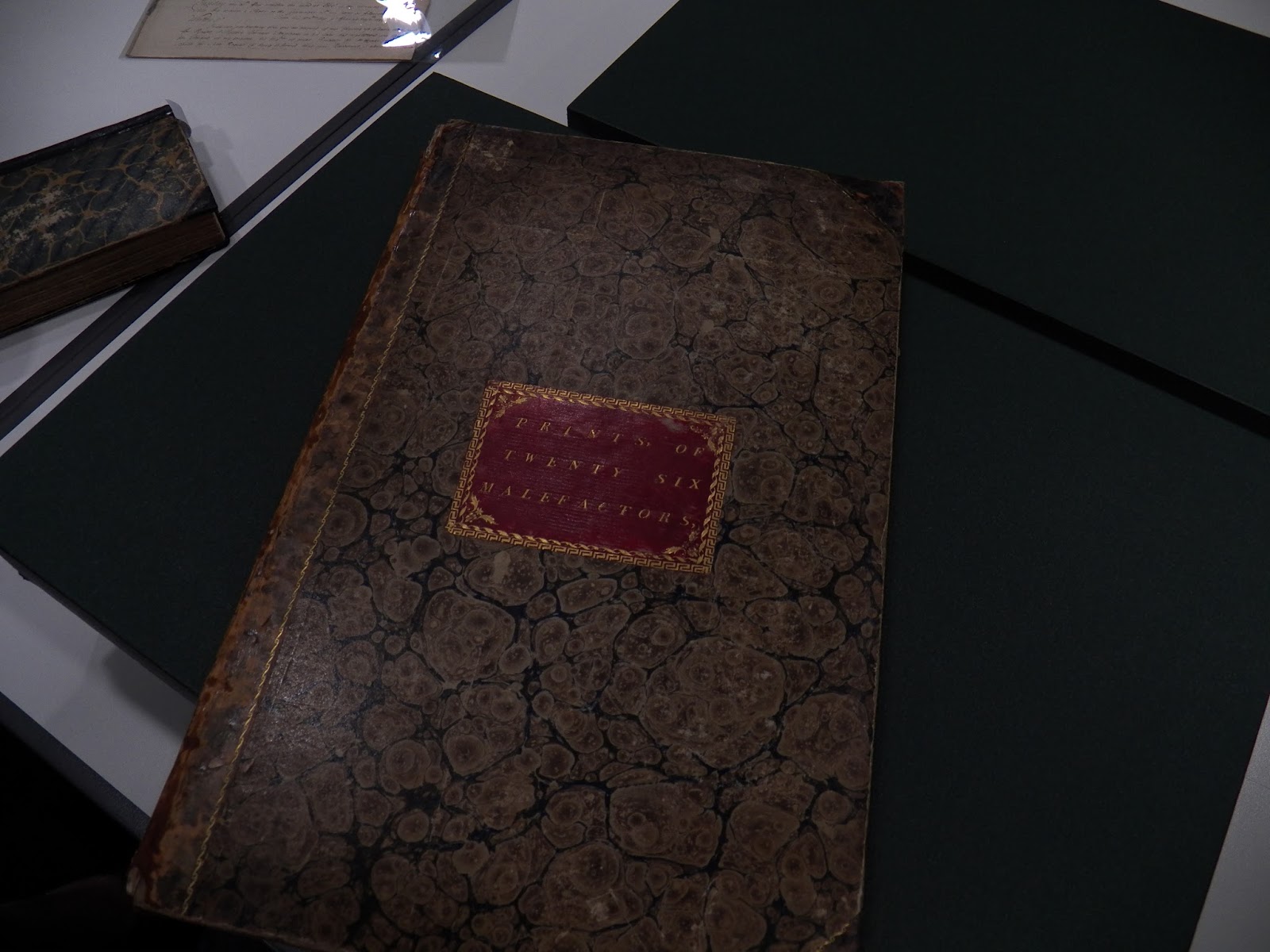
After our tour, Mark (the Archivist) showed us some really great items from the collection.  My favorite was a folio of prints titled "Prints of Twenty-Six Malefactors."  The prints were all of well-known pirates and undesirables from the time.  In fact, the pirate stuff he showed us was all very interesting - a) because pirates are cool, and b) because pirates don't really tend to keep records.  Letters and journals from pirates were very rare because many could not read or write, and let's face it: pirates aren't really known for their record keeping skills.

We spent the rest of the afternoon wandering around Greenwich, visiting the shops and walking around the town.  I had lunch in Jamie Oliver's restaurant there, Jamie's Italian - scallops in black squid ink pasta (delicious!).  Upon returning, we were whisked away to the program convocation reception at King's College chapel, a beautiful space I am happy to have seen.  We finished the night at The Thirsty Bear, which held a reception for the students.